Summary
What is the risk?
At the mouth of Ilulissat Icefjord, the Jakobshavn Glacier lurches forward at about forty meters a day. Each summer, its face leans toward the sea, heavy with centuries of compressed snowfall, until something inside it gives. A crack begins high up in the wall of ice—then, like a fault unzipping, it widens and deepens until a block the size of a city slides forward.
Climate change is the long-term alteration of the Earth’s climate system, driven primarily by the accumulation of greenhouse gases. This warming affects the atmosphere, oceans, land, and cryosphere — the systems that regulate planetary stability. Each of the past ten years (2015–2024) has ranked among the warmest on record, and according to the World Meteorological Organization, 2024’s global mean temperature was about 1.55°C above the 1850–1900 pre-industrial average.[1] While short-term variations occur, the long-term trend is unmistakable: the planet is warming at an accelerating pace.
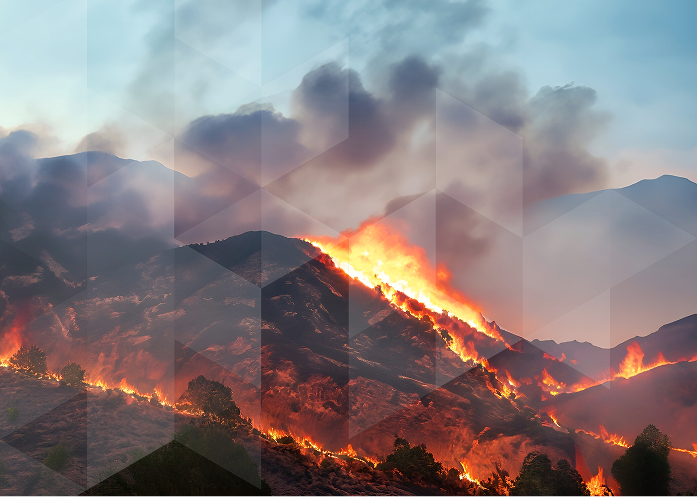
A single year above the 1.5°C threshold set by the Paris Agreement does not yet mark permanent overshoot but shows how close we are to destabilising key Earth systems. Even at today’s levels, intensifying heatwaves, droughts, wildfires, and floods are straining societies — with the harshest impacts on those least responsible for emissions. The risk lies not only in continued warming but in cascading disruptions that could move the climate beyond human control. Each fraction of a degree narrows the space for stability
What is at stake?
If warming exceeds 1.5°C it will lead to increasingly frequent and dangerous extreme weather events (ref). Every additional 0.1°C of global warming causes increases in the intensity and frequency of temperature extremes, both now when the Earth systems are “stabilised” and in the overshoot period above 1.5°C(ref).
In a more extreme case, If warming exceeds 3°C, the planet could enter conditions unseen for millions of years (ref). Sea-level rise, crop failures, and extreme heat would render regions uninhabitable and trigger mass displacement. Ecosystem collapse would undermine food, water, and climate regulation.
Climate change is not linear: once tipping points are crossed, self-reinforcing feedbacks – melting ice, thawing permafrost, dying forests – can accelerate change (ref). Some systems are already near these limits. Coral reefs, for instance, have passed their tipping point and may lose most function within a decade (ref).
The Global Tipping Points Report (2025) finds that preventing this requires minimising overshoot above 1.5°C and ultimately stabilising below 1.0°C on a longer timescale through urgent, coordinated global action.
What are the driving forces and causes?
Climate change is driven by a combination of physical, economic, and social forces that together disrupt the Earth’s energy balance and carbon cycle. These drivers can be grouped into four interrelated areas.
1. Greenhouse gas emissions from human activity
The dominant cause of global warming is the accumulation of greenhouse gases in the atmosphere. According to the Intergovernmental Panel on Climate Change (IPCC), emissions from fossil fuel combustion, industry, and agriculture are responsible for nearly all observed warming since the mid-20th century. Carbon dioxide accounts for about three-quarters of global emissions, largely from energy and transport, while methane and nitrous oxide from livestock, fertilizers, and waste add significant additional forcing.
2. Land use and ecosystem degradation
Deforestation, land conversion, and the loss of peatlands and coastal wetlands release stored carbon and weaken natural carbon sinks. These ecosystems also moderate local climates and store moisture; their destruction intensifies regional warming, drought, and biodiversity loss. Land-use change accounts for roughly one-fifth of historical emissions and continues to erode the biosphere’s capacity to regulate the climate.
3. Economic and structural dependence on fossil fuels
The global economy remains locked into high-emission infrastructure and consumption systems — from energy and transport to industry and food. Capital, trade, and subsidies reinforce this dependence, creating powerful inertia that delays transition.
4. Social, political, and behavioural drivers
Lifestyles, consumption patterns, and inequitable resource use contribute substantially to emissions disparities both within and between nations. Wealthier populations have far higher per capita footprints, while limited awareness and delayed policy action reinforce the trajectory. Together, these social and political dynamics sustain the structural causes of climate change.
What is being done to govern catastrophic climate change and where are there gaps?
Global climate governance is anchored in the Paris Agreement (2015), where nations pledged to limit warming to “well below” 2°C and pursue efforts to stay below 1.5°C but current national pledges remain far below what science indicates is necessary.
Successive UN Climate Conferences (COPs) have advanced climate diplomacy through new pledges on loss and damage, methane, and deforestation. However, climate policies remain fragmented — separated from related domains such as biodiversity, energy, food, and finance — despite their deep interconnections. This lack of systemic integration weakens collective capacity to anticipate and manage cascading risks.
Unequal access to finance and technology as well as lack of institutional capacity further limits the ability of countries, not least low- and middle-income countries to both adapt and transition away from fossil fuels.
Beyond technical and economic barriers lies a deeper leadership gap. There is a huge implementation gap in relation to what is needed according to science. Avoiding catastrophic climate change requires political courage to confront vested interests and align economic priorities with the Paris agreement and planetary boundaries. Incremental diplomacy and short-term agendas are no longer sufficient.
Bridging these gaps requires a shift from reactive diplomacy to systemic risk governance: anticipating cascading effects, aligning institutions around shared planetary boundaries, treating climate stability as a foundation for security and prosperity, and fostering political coalitions capable of sustaining deep transformation.
Listen to our podcast about this risk
Scientific article
Governing the Unthinkable: Imagination and Responsibility in the Age of Earth System Tipping Points
At the mouth of Ilulissat Icefjord, the Jakobshavn Glacier lurches forward at about forty meters a day. Each summer, its face leans toward the sea, heavy with centuries of compressed snowfall, until something inside it gives. A crack begins high up in the wall of ice—then, like a fault unzipping, it widens and deepens until a block the size of a city slides forward.
The sound is less an explosion than a deep, resonant exhale, a noise you feel in the chest. Within minutes the newborn iceberg turns, sending waves shuddering against the fjord’s black water, and moves out to sea.
Scientists log the event, satellites record the plume of ice dust. But the real data point is invisible: another infinitesimal step toward a planet reorganizing itself. The moment is both ordinary and epochal—another Tuesday in Ilulissat, a threshold in the Earth system.
What is breaking here is not just ice, but the continuity that governance depends on. The rules we’ve written for a stable world no longer fit the one that’s forming in front of us.
From Control to Navigating Complexity: What Makes Tipping Points Different
What begins at Jakobshavn does not stay in Greenland. The ice released into the Labrador Sea changes the density of the ocean, nudging the great Atlantic circulation that shapes weather across half the planet (REF). Far away, rainforests dry more quickly, and the rhythms of the monsoon begin to drift (REF). Such connections reveal a deeper insight: tipping points are not only regional breakdowns but planetary reorganizations (Wunderling et al. 2024).
This is what distinguishes tipping points from the climate change we are accustomed to managing. They transform the basic grammar of governance (Milkoreit et al. 2024).
Thresholds and Reorganization: Conventional climate governance assumes continuity. It relies on temperature targets, carbon budgets, and sea-level projections—tools suited to gradual, predictable, reversible change. But tipping points violate that logic. They are moments of commitment to irrevocable systemic shifts. When thresholds are crossed, Earth systems do not simply deteriorate—they become something new. An unfamiliar territory for social organization and human development. Governance can no longer aim only to optimize or adapt within a stable baseline; it must anticipate disruption, prioritize prevention and learn to navigate complexity.
This requires a shift toward precautionary, adaptive, and integrative governance—approaches that recognize uncertainty and work across domains. Climate, biodiversity, marine, and land systems cannot be governed in isolation when the processes binding them together may reorganize as one. Today’s institutional silos—each tasked with managing a piece of stability—must give way to governance capable of navigating the dynamics of the whole.
Temporal Dislocation and Irreversibility: The second challenge is temporal. Tipping points collapse time in the moment of crisis yet expand it indefinitely through their consequences. The dieback of a forest or the loss of an ice sheet unfold over decades and centuries. But the decisions that determine these outcomes are being made now, within election cycles, planning periods, and fiscal years.
This temporal dislocation compresses moral and political responsibility in the present: we hold unprecedented power to shape conditions far beyond our own lifetimes. Traditional democratic structures, oriented to immediate consent and near-term accountability, struggle to represent such extended futures and those affected by them. Governing tipping points therefore demands anticipatory and intergenerational capacities—institutions that can sense early warnings, act before certainty, and give political voice to those who will live with the results. In this context, precaution is not a constraint on democracy; it is its temporal deepening.
Cascades and Systemic Ripples: Tipping points also rarely occur in isolation. The destabilization of Greenland may slow the Atlantic circulation, which in turn alters rainfall and accelerates forest decline. These are cascading dynamics in a strongly coupled system. Effective governance must therefore become systemic—aware of linkages, able to detect cross-scale interactions and coordinate responses across policy arenas, jurisdictions, and timeframes (Schweizer 2021).
Emerging scholarship on Earth system governance and complexity points toward this evolution: reflexive, polycentric, and inclusive forms of decision-making that treat governance itself as an adaptive system (Galaz 2014, Day 2024). Yet most political architectures remain designed for stability, not surprise.
To govern tipping points, then, is not to restore the past but to guide and navigate Earth-human-system transformation—to steer societies toward wellbeing and habitability as the Earth reorganizes. It is an invitation to match the planet’s capacity for systemic change with an equal capacity for collective foresight and care.
The Moral Imagination of Planetary Governance
To live in a world of tipping points is to inhabit a planet where the familiar boundaries of time, space, and responsibility dissolve. Governance is no longer only about managing emissions or protecting ecosystems; it becomes about imagining the future as latent – something already unfolding through our choices (Adam and Groves 1992).
Meeting this challenge demands more than institutional reform. It calls for a new governance imagination—one that can see the Earth as a dynamic, interdependent system with humanity as a participant – subject and object of change. The imagination of the past was instrumental: how to predict, optimize, and control. The imagination needed now is moral and planetary. It asks what forms of care, restraint, and cooperation are possible when feedbacks transcend borders, scales, and timeframes.
Democratic governance faces both peril and promise here. Its short-term cycles make it ill-suited to deep time, yet its capacity for collective deliberation offers the best hope of navigating it. To govern tipping points, democracy must expand—through time, to represent future generations; and across space, to embrace the global interdependence of Earth’s systems.
Innovations such as citizens’ assemblies—deliberative forums that gather diverse publics to confront complex choices—illustrate how this imagination might be institutionalized. Experimented with in national contexts, they could one day operate at the planetary scale, offering a venue where moral reasoning and scientific understanding meet.
Imagination, in this sense, is not escapism; it is a governance capacity. Without it, policy becomes reactive, chasing crises as they unfold. With it, societies can orient themselves toward futures still within reach. The capacity to picture what does not yet exist—to deliberate about worlds we will not personally inhabit—is what allows governance to stretch beyond the present moment.
Ultimately, this is a moral task. To govern tipping points is to decide what forms of life and relation we wish to preserve. It requires humility about what cannot be known, and courage to act before it is. Our task is not to control the Earth’s transformation, but to participate in it wisely—ensuring that as the planet’s great stabilizing systems approach thresholds, our values keep up with the immensity of the challenge.
Edi rem id quundellum dolupis cum sequist accatecum, quae pro
Conclusion: A Mandate for Imagination
Every calving is an ending and a beginning. The cryosphere remakes itself, and so must we. For decades, we governed as if the planet would yield to management plans, targets and self-interests, as if linear progress pursued in national boundaries could hold a nonlinear world that ignores borders and scales. But here, among the echoes of ice collapsing into water, governance meets its limit—and perhaps its renewal.
If tipping points mark the boundaries of the Earth’s resilience, they also define the frontier of human responsibility. We cannot govern these risks through management alone; we must reimagine governance itself—as a shared, anticipatory practice capable of shaping transformation before it overtakes us.
This is a moment to claim a new public mandate: to make imagination a civic and global responsibility. Institutions, scientists, and citizens alike must learn to act across generations and borders, to guide reorganization rather than resist it. The time for such imagination is now; the mandate is ours.

Testing
Lorem ipsum
Text text Text text Text text Text text Text text Text text
Other risks

Catastrophic Climate change – old
What is the risk? At the mouth of Ilulissat Icefjord, the Jakobshavn Glacier lurches forward at about forty meters a…
Ecological Collapse
Lorem ipsum Ecological Collapse Lorem ipsum dolor sit amet, consectetur adipiscing elit. Suspendisse posuere lacinia dui ut pretium. Aenean sit…
Nuclear Weapons
Climate change is the long-term alteration of the Earth’s climate system, driven primarily by the accumulation of greenhouse gases. Nuclear…

Articifical Intelligence
Curabitur vel pellentesque libero. Suspendisse vitae magna leo. Integer vestibulum magna nec urna consequat, vel tincidunt urna dignissim. Phasellus vestibulum…

Near Earth Asteroids
Curabitur vel pellentesque libero. Suspendisse vitae magna leo. Integer vestibulum magna nec urna consequat, vel tincidunt urna dignissim. Phasellus vestibulum…